
Air-drying or baking winding varnish?
If you have no oven or do repair and field work, choose air-drying varnish (OR 1xx); it dries at room temperature and needs no extra equipment. If you do series winding, have an oven and the motor will run in demanding conditions, choose baking varnish (OR 3xx); it cures in an oven and gives the highest bond strength.
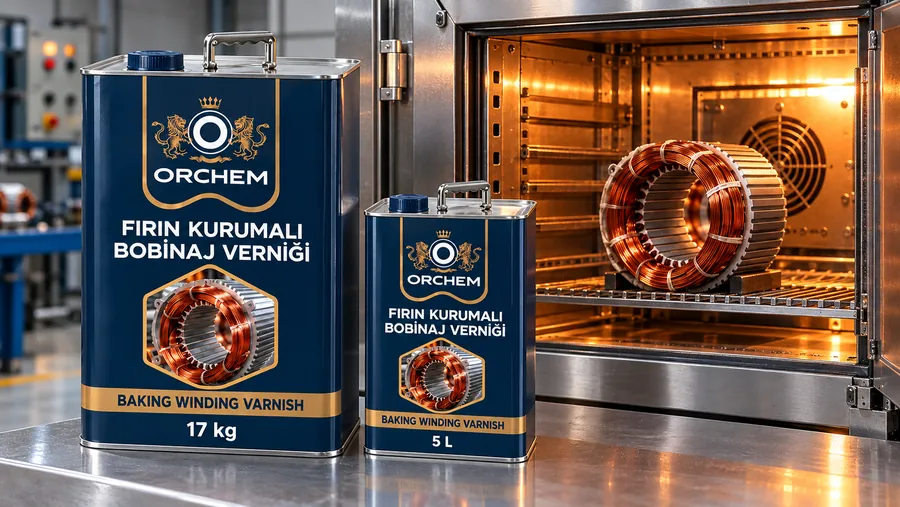
The basic difference: how the varnish hardens
Air-drying varnish hardens at room temperature as its solvent evaporates and the varnish is exposed to air. No oven, heater or special equipment is needed; the varnished motor is simply left to dry.
Baking varnish cures with heat. When baked at the recommended temperature and time, the resin fully cross-links and turns the winding into a single hard body. Left in air, it does not cure fully.
Comparison
| Air-drying (OR 1xx) | Baking (OR 3xx) | |
|---|---|---|
| Curing | At room temperature | In an oven, following the recommended temperature–time schedule |
| Equipment needed | None | Curing oven |
| Bond strength | Good | Highest; locks the wires firmly |
| Heat and moisture resistance | Good | Very good |
| Resistance to hot transformer oil | — | Yes |
| Waiting time and workflow | Motor waits in the workshop until dry | Oven time is fixed, so work can be scheduled |
| Extra cost | None | Oven investment and energy |
| Best for | Repairs, single motors, field work, urgent jobs | Series winding, factories, heavy duty |
Which one, when?
Choose air-drying if:
- you have no oven, or the motor does not fit in it,
- you run a repair shop and different motors come in every day,
- you work in the field without removing the motor,
- you are winding a general-purpose motor that runs in normal conditions.
Choose baking if:
- you do series winding and want the same quality in every motor,
- the motor will run with vibration, at high speed or under heavy load,
- the winding will operate in humid environments, in a submersible pump or in hot oil,
- you have an oven and can schedule the work.
If you are undecided, ask: what would it cost if this motor came back? For heavy-duty motors whose failure would be expensive, baking varnish is the safer choice.
How to apply air-drying varnish
- Clean the winding; preheat old motors to drive out moisture.
- Thin the varnish with its own thinner (T-100), generally 3 parts varnish to 1 part thinner.
- Dip, or work it well into the winding with a brush.
- Drain off the excess; do not leave pools.
- Leave it to dry in a warm, dry, ventilated place for the time stated in the TDS.
How to apply baking varnish
- Clean the winding and dry it by preheating.
- Thin the varnish with its own thinner (T-300), generally 3 parts varnish to 1 part thinner.
- Impregnate by dipping; keep it immersed until bubbles stop rising.
- Drain off the excess.
- Put it in the oven and apply the recommended temperature–time schedule. Start timing once the part reaches oven temperature.
- Do not take it out before the time is up; let the motor cool completely before running it.
For thinner choice and ratio, see our thinner guide.
Using both together
For a workshop without an oven whose motor will run in harsh conditions, there is a practical route: varnish the winding with air-drying OR 1xx and, once fully dry, apply an insulating top coat. The top coat adds an extra layer of protection against moisture and corrosion. For touch-ups on connections and terminals, use motor insulating spray.
Common mistakes
- Leaving baking varnish to air-dry: the surface may look dry, but it does not cure and stays tacky. See our guide on why winding varnish won't dry.
- Mixing the two types in one tank: air-drying and baking varnish must not be added to each other; drying is impaired.
- Mixing thinners: do not add T-300 to air-drying varnish or T-100 to baking varnish.
- Trying to air-dry in a cold workshop: drying takes far longer; move the motor somewhere warm.
Which varnish is right for you?
Tell us your motor type, operating temperature and application method, and we will send the suitable Orchem varnish and its TDS.
Frequently asked
Is air-drying varnish as durable as baking varnish?
It provides sufficient durability for general-purpose motors. However, the highest bond strength, heat and moisture resistance and resistance to hot transformer oil are achieved with baking varnish.
Can I use baking varnish without an oven?
No. Baking varnish cures fully only when baked at the recommended temperature and time. If you have no oven, choose air-drying varnish.
Can air-drying and baking varnish be mixed?
No. Do not mix the two types in the same container or dip tank; use each varnish with its own thinner.
Which one for submersible pumps?
If you have an oven, baking OR 3xx. Without an oven, varnish with air-drying OR 1xx and apply an insulating top coat on top.