
Which thinner for winding varnish, and at what ratio?
For general use, add 1 part thinner to 3 parts varnish. Orchem air-drying varnishes are thinned with T-100, OKA-501 varnish with T-501 and baking varnishes with T-300. Always thin each varnish with its own thinner; check the product TDS for the exact ratio.
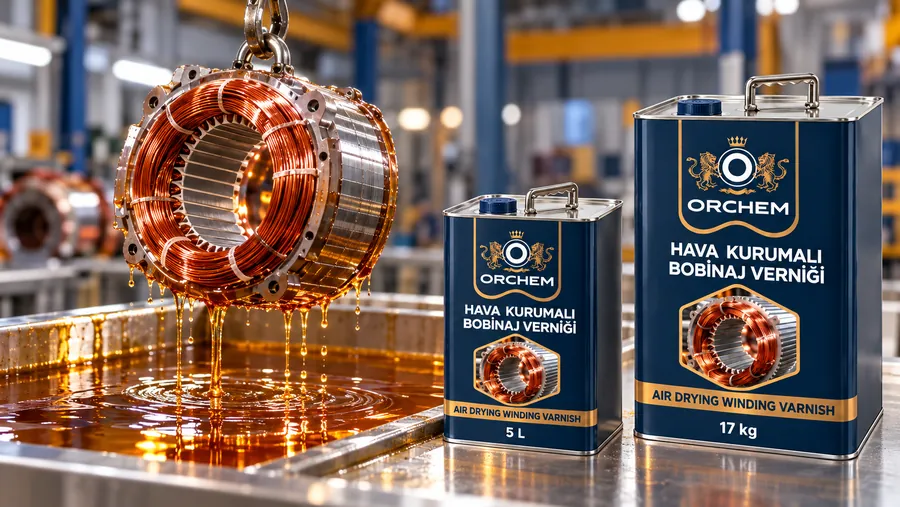
Which thinner for which varnish?
| Varnish | Thinner | General ratio |
|---|---|---|
| Air-drying varnishes (OR 1xx) | T-100 | 3 varnish : 1 thinner |
| OKA-501 varnish | T-501 | 3 varnish : 1 thinner |
| Baking varnishes (OR 3xx) | T-300 | 3 varnish : 1 thinner |
The ratio in the table is for general use. Small adjustments may be needed depending on the application method and ambient temperature; check the product TDS or ask us for the exact value.
What does "3 to 1" mean?
Take 3 measures of varnish and add 1 measure of thinner, using the same measuring container. For example, 3 liters of varnish plus 1 liter of thinner gives 4 liters of ready-to-use varnish. Measure with a container rather than by eye, and you will get the same consistency every time.
Why thin the varnish?
- For penetration: the varnish must reach the innermost wires of the winding. Varnish that is too thick stays on the surface and leaves voids inside.
- For the dip tank: solvent evaporates from the tank over time and the varnish thickens. Thinner is added from time to time to keep the consistency.
- For the application method: brush, dipping and spray gun each need a different consistency. When spraying, adjust the consistency to suit your gun.
Mixing correctly
- Use a clean, dry container with no old varnish or other chemicals in it.
- Pour the varnish first, then add the thinner little by little.
- Stir thoroughly, scraping the bottom of the container.
- Store unused thinned varnish in a tightly closed container.
- Work in a well-ventilated area; thinner and varnish vapors are flammable, so keep away from open flames.
Too much, too little or the wrong thinner
- Too much thinner: the varnish film becomes thin and too little varnish stays on the winding; insulation and bond strength drop, and the varnish runs.
- Too little thinner: the varnish does not penetrate between the turns, a thick layer forms on the surface and drying takes longer.
- The wrong thinner: an incompatible solvent can cloud or separate the varnish or impair drying. Always thin each varnish with its own thinner.
To choose the right varnish in the first place, see our guide on which winding varnish to use.
Which varnish is right for you?
Tell us your motor type, operating temperature and application method, and we will send the suitable Orchem varnish and its TDS.
Frequently asked
Can I thin winding varnish with nitrocellulose thinner?
Not recommended. Each Orchem varnish is matched to its own thinner: T-100 for air-drying, T-501 for OKA-501 and T-300 for baking varnishes. A different thinner can impair drying and insulation.
When should thinner be added to the dip tank?
As the tank is used, solvent evaporates and the varnish thickens. When the consistency has clearly thickened compared to the start, add a small amount of the matching thinner and stir well.
Is the 3:1 ratio by weight or by volume?
In the workshop, the practical way is to add 1 measure of thinner to 3 measures of varnish using the same container. For precise production, follow the value in the product TDS.